
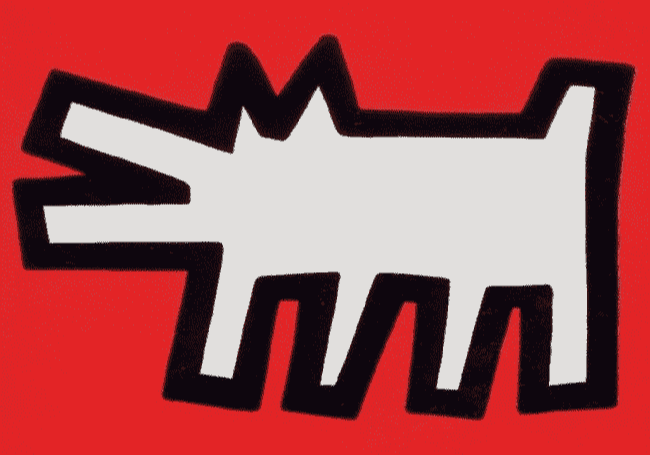
Red Dog
by Keith Haring
Year: 1990
Medium: Silkscreen
Size: 25 x 21 in (63.5 x 53.34 cm)
Signed
Edition: 250
Among Keith Haring’s final-period works, Red Dog (1990) presents the artist’s signature graphic energy in a 25 × 21-inch (63.5 × 53.34 cm) silkscreen. Signed and issued in an edition of 250, the print reflects Haring’s enduring dialogue with street culture, Pop imagery, and public art. Its bold iconography, compact scale, and documented edition make it an appealing acquisition for collectors of late Haring.
Red Dog is one of Keith Haring’s most recognizable symbols, rooted in the subway drawings that first brought his visual language to New York audiences in the early 1980s. The barking dog began as a street-born motif, so this image has a direct connection to Haring’s graffiti practice—even though the 1990 Red Dog screenprint itself is a studio edition, not a subway drawing. Haring later transformed the motif into sculpture, including the important Red Dog steel works of 1986–87.
The dog’s raised posture and open mouth suggest both energy and warning. Haring used the barking dog as a symbol of authority, aggression, and abuses of power, giving this deceptively simple image a sharper social edge.
For collectors, the 1990 screenprint is signed and numbered in an edition of 250. Its place within Haring’s Icons portfolio makes it highly recognizable and easy to position within a major Haring collection. Auction records confirm active demand, including a £575 result at Chiswick Auctions.
What makes Red Dog especially compelling is its career-spanning role: the same symbol moves from subway drawing to sculpture and print, showing Haring’s rare ability to turn street vocabulary into enduring contemporary art.
More Keith Haring Works to Explore
Red Dog
by Keith Haring
Year: 1990
Medium: Silkscreen
Size: 25 x 21 in (63.5 x 53.34 cm)
Signed
Among Keith Haring’s final-period works, Red Dog (1990) presents the artist’s signature graphic energy in a 25 × 21-inch (63.5 × 53.34 cm) silkscreen. Signed and issued in an edition of 250, the print reflects Haring’s enduring dialogue with street culture, Pop imagery, and public art. Its bold iconography, compact scale, and documented edition make it an appealing acquisition for collectors of late Haring.
Red Dog is one of Keith Haring’s most recognizable symbols, rooted in the subway drawings that first brought his visual language to New York audiences in the early 1980s. The barking dog began as a street-born motif, so this image has a direct connection to Haring’s graffiti practice—even though the 1990 Red Dog screenprint itself is a studio edition, not a subway drawing. Haring later transformed the motif into sculpture, including the important Red Dog steel works of 1986–87.
The dog’s raised posture and open mouth suggest both energy and warning. Haring used the barking dog as a symbol of authority, aggression, and abuses of power, giving this deceptively simple image a sharper social edge.
For collectors, the 1990 screenprint is signed and numbered in an edition of 250. Its place within Haring’s Icons portfolio makes it highly recognizable and easy to position within a major Haring collection. Auction records confirm active demand, including a £575 result at Chiswick Auctions.
What makes Red Dog especially compelling is its career-spanning role: the same symbol moves from subway drawing to sculpture and print, showing Haring’s rare ability to turn street vocabulary into enduring contemporary art.