
1 Pop Shop Ii
by Keith Haring
Year: 1988
Medium: Silkscreen
Size: 13 × 16 in (33.02 x 40.64 cm)
Edition: 200
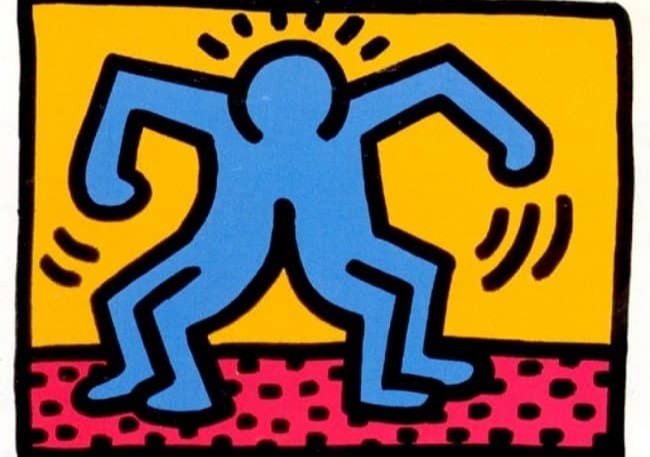
From Keith Haring’s celebrated Pop Shop period, 1 Pop Shop II (1988) is a silkscreen measuring 13 × 16 inches (33.02 × 40.64 cm), issued in an edition of 200. Reflecting Haring’s pioneering blend of street culture, fine art, and popular imagery, the work distills his energetic visual language into an accessible collectible. Its period significance and enduring cultural resonance make it a compelling choice for discerning collectors.
Pop Shop II (1) by Keith Haring is the opening plate of his 1988 Pop Shop II portfolio, created as Haring expanded his mission to make art accessible beyond the gallery. The series followed his original New York Pop Shop, launched in 1986, and reflects the artist’s belief that art could live in everyday culture. It is not a street-graffiti edition; rather, Haring translated the energy of his subway drawings into a signed, editioned screenprint.
A blue figure stretches upward with arms open, surrounded by kinetic marks. The simple form suggests freedom, movement, joy, and human connection, while the strong black outline gives the image the instant visual impact that made Haring’s work so influential.
For collectors, Pop Shop II (1) offers a strong balance of rarity and market relevance. The edition is limited to 200, with additional artist’s proofs, and the work is documented as Littmann p. 96. Its auction history shows sustained demand, including a $53,094 result at Phillips in 2022.
At ArtLife Gallery, we consider this an excellent Haring for collectors who want a recognizable 1980s work with real historical depth. It connects directly to Pop Shop II Plates 2–4, Pop Shop Quad II, Pop Shop I, and Haring’s subway drawings—making it a smart addition to a serious contemporary art collection.
Keith Haring (1958–1990) was an influential American artist known for his bold lines, vivid colors, and instantly recognizable figures that helped define the New York art scene of the 1980s. Combining elements of Pop Art, graffiti, and street culture, Haring created energetic artworks featuring dancing figures, barking dogs, radiant babies, and symbolic imagery exploring humanity, love, social justice, and political activism.
Born in Reading, Pennsylvania, Haring moved to New York City in 1978 to study at the School of Visual Arts. He gained public attention through his chalk drawings on unused subway advertising panels, transforming everyday urban spaces into accessible public art. His distinctive visual language soon attracted international recognition and led to exhibitions, collaborations, and large-scale murals.
In 1986, Haring opened the Pop Shop in Manhattan, offering prints, clothing, and other products featuring his designs. The shop reflected his belief that art should reach people beyond traditional galleries and museums. Throughout his career, he addressed important social issues, including racism, apartheid, drug abuse, and the AIDS epidemic.
After being diagnosed with AIDS in 1988, Haring continued creating art and established the Keith Haring Foundation in 1989 to support AIDS-related organizations and children's programs. He died in 1990, aged 31, leaving a lasting legacy in contemporary art.
Today, Keith Haring art prints and original artworks remain sought after by collectors worldwide. Understanding an artwork's edition, condition, provenance, and market history is essential when evaluating its value. Explore our guide to Keith Haring print valuation and learn more about the investment potential of Keith Haring art.
More Keith Haring Works to Explore


1 Pop Shop Ii
by Keith Haring
Year: 1988
Medium: Silkscreen
Size: 13 × 16 in (33.02 x 40.64 cm)
Edition: 200
From Keith Haring’s celebrated Pop Shop period, 1 Pop Shop II (1988) is a silkscreen measuring 13 × 16 inches (33.02 × 40.64 cm), issued in an edition of 200. Reflecting Haring’s pioneering blend of street culture, fine art, and popular imagery, the work distills his energetic visual language into an accessible collectible. Its period significance and enduring cultural resonance make it a compelling choice for discerning collectors.
Pop Shop II (1) by Keith Haring is the opening plate of his 1988 Pop Shop II portfolio, created as Haring expanded his mission to make art accessible beyond the gallery. The series followed his original New York Pop Shop, launched in 1986, and reflects the artist’s belief that art could live in everyday culture. It is not a street-graffiti edition; rather, Haring translated the energy of his subway drawings into a signed, editioned screenprint.
A blue figure stretches upward with arms open, surrounded by kinetic marks. The simple form suggests freedom, movement, joy, and human connection, while the strong black outline gives the image the instant visual impact that made Haring’s work so influential.
For collectors, Pop Shop II (1) offers a strong balance of rarity and market relevance. The edition is limited to 200, with additional artist’s proofs, and the work is documented as Littmann p. 96. Its auction history shows sustained demand, including a $53,094 result at Phillips in 2022.
At ArtLife Gallery, we consider this an excellent Haring for collectors who want a recognizable 1980s work with real historical depth. It connects directly to Pop Shop II Plates 2–4, Pop Shop Quad II, Pop Shop I, and Haring’s subway drawings—making it a smart addition to a serious contemporary art collection.
Keith Haring (1958–1990) was an influential American artist known for his bold lines, vivid colors, and instantly recognizable figures that helped define the New York art scene of the 1980s. Combining elements of Pop Art, graffiti, and street culture, Haring created energetic artworks featuring dancing figures, barking dogs, radiant babies, and symbolic imagery exploring humanity, love, social justice, and political activism.
Born in Reading, Pennsylvania, Haring moved to New York City in 1978 to study at the School of Visual Arts. He gained public attention through his chalk drawings on unused subway advertising panels, transforming everyday urban spaces into accessible public art. His distinctive visual language soon attracted international recognition and led to exhibitions, collaborations, and large-scale murals.
In 1986, Haring opened the Pop Shop in Manhattan, offering prints, clothing, and other products featuring his designs. The shop reflected his belief that art should reach people beyond traditional galleries and museums. Throughout his career, he addressed important social issues, including racism, apartheid, drug abuse, and the AIDS epidemic.
After being diagnosed with AIDS in 1988, Haring continued creating art and established the Keith Haring Foundation in 1989 to support AIDS-related organizations and children's programs. He died in 1990, aged 31, leaving a lasting legacy in contemporary art.
Today, Keith Haring art prints and original artworks remain sought after by collectors worldwide. Understanding an artwork's edition, condition, provenance, and market history is essential when evaluating its value. Explore our guide to Keith Haring print valuation and learn more about the investment potential of Keith Haring art.