
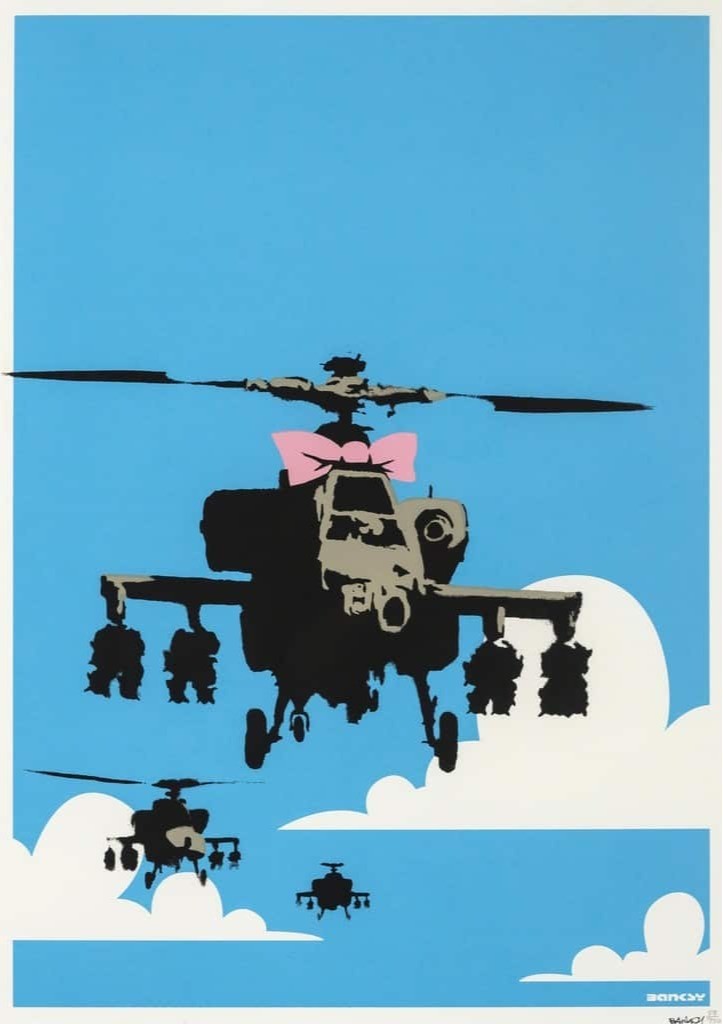
Happy Choppers
by Banksy
Year: 2003
Medium: Screenprint on paper
Size: 50 x 70 cm
Edition of 150
Banksy’s Happy Choppers (2003) is a rare screenprint on paper measuring 50 × 70 cm, issued in a limited edition of 150. Created during the artist’s early defining period, the work juxtaposes militaristic imagery with a subversive sense of irony, reflecting his critique of conflict, power, and media spectacle. Its scarce edition and refined composition enhance its desirability, while established authentication standards provide strong provenance, supporting confidence among discerning contemporary art collectors.
Banksy’s Happy Choppers first appeared as a screen print in the early 2000s, during a period when the artist was increasingly focused on militarism, media imagery, and the contrast between violence and public messaging. The work is widely associated with Banksy’s print releases rather than a confirmed large-scale street mural, as its controlled composition and repeated production format were intended for the gallery and collector market rather than site-specific graffiti intervention.
The image depicts military helicopters rendered in a bright, almost cheerful aesthetic, often paired with decorative or ironic visual elements. This clash between form and subject creates a direct commentary on how warfare is presented and normalized in modern media. The work explores themes of conflict, propaganda, and desensitization, questioning how violent systems are reframed through design, branding, and repetition.
Within Banksy’s wider practice, Happy Choppers reflects his recurring use of irony to expose the tension between public perception and political reality. The playful presentation contrasts sharply with the seriousness of its subject, reinforcing the artist’s critique of institutional messaging.
For collectors, Happy Choppers remains a sought-after Banksy print due to its rarity, strong visual identity, and clear political message. Demand continues in the secondary market, driven by its cultural relevance and its place within Banksy’s most recognizable anti-war imagery. Today, it stands as a key example of how Banksy translates conflict into visually accessible but conceptually challenging work.
Banksy is a world-famous British street artist known for politically charged graffiti and an anonymous identity. Emerging from the Bristol underground scene in the 1990s, Banksy became a leading figure connecting street art, graffiti art, and contemporary art movements. His work combines satire, activism, and social commentary in ways that connect with both casual viewers and serious collectors.
Banksy’s iconic works, such as Girl with Balloon, Flower Thrower, and Love is in the Bin helped define his career and transformed street art into a respected part of the global art market. His visual style is instantly recognizable through stencil techniques, bold black-and-white contrasts, and sharp messages about war, consumerism, and inequality.
Banksy holds major market importance because his original works and authenticated prints regularly sell for millions at international auctions. Demand remains strong among collectors due to limited supply, global recognition, and cultural relevance.
Beyond the market, Banksy changed how people view public art. He brought graffiti into galleries, museums, and mainstream culture while keeping its rebellious spirit alive. From an investment perspective, Banksy is considered one of the strongest contemporary art names, with steady collector demand and long-term appeal across generations.
More Banksy Works to Explore





Happy Choppers
by Banksy
Year: 2003
Medium: Screenprint on paper
Size: 50 x 70 cm
Edition of 150
Banksy’s Happy Choppers (2003) is a rare screenprint on paper measuring 50 × 70 cm, issued in a limited edition of 150. Created during the artist’s early defining period, the work juxtaposes militaristic imagery with a subversive sense of irony, reflecting his critique of conflict, power, and media spectacle. Its scarce edition and refined composition enhance its desirability, while established authentication standards provide strong provenance, supporting confidence among discerning contemporary art collectors.
Banksy’s Happy Choppers first appeared as a screen print in the early 2000s, during a period when the artist was increasingly focused on militarism, media imagery, and the contrast between violence and public messaging. The work is widely associated with Banksy’s print releases rather than a confirmed large-scale street mural, as its controlled composition and repeated production format were intended for the gallery and collector market rather than site-specific graffiti intervention.
The image depicts military helicopters rendered in a bright, almost cheerful aesthetic, often paired with decorative or ironic visual elements. This clash between form and subject creates a direct commentary on how warfare is presented and normalized in modern media. The work explores themes of conflict, propaganda, and desensitization, questioning how violent systems are reframed through design, branding, and repetition.
Within Banksy’s wider practice, Happy Choppers reflects his recurring use of irony to expose the tension between public perception and political reality. The playful presentation contrasts sharply with the seriousness of its subject, reinforcing the artist’s critique of institutional messaging.
For collectors, Happy Choppers remains a sought-after Banksy print due to its rarity, strong visual identity, and clear political message. Demand continues in the secondary market, driven by its cultural relevance and its place within Banksy’s most recognizable anti-war imagery. Today, it stands as a key example of how Banksy translates conflict into visually accessible but conceptually challenging work.
Banksy is a world-famous British street artist known for politically charged graffiti and an anonymous identity. Emerging from the Bristol underground scene in the 1990s, Banksy became a leading figure connecting street art, graffiti art, and contemporary art movements. His work combines satire, activism, and social commentary in ways that connect with both casual viewers and serious collectors.
Banksy’s iconic works, such as Girl with Balloon, Flower Thrower, and Love is in the Bin helped define his career and transformed street art into a respected part of the global art market. His visual style is instantly recognizable through stencil techniques, bold black-and-white contrasts, and sharp messages about war, consumerism, and inequality.
Banksy holds major market importance because his original works and authenticated prints regularly sell for millions at international auctions. Demand remains strong among collectors due to limited supply, global recognition, and cultural relevance.
Beyond the market, Banksy changed how people view public art. He brought graffiti into galleries, museums, and mainstream culture while keeping its rebellious spirit alive. From an investment perspective, Banksy is considered one of the strongest contemporary art names, with steady collector demand and long-term appeal across generations.