
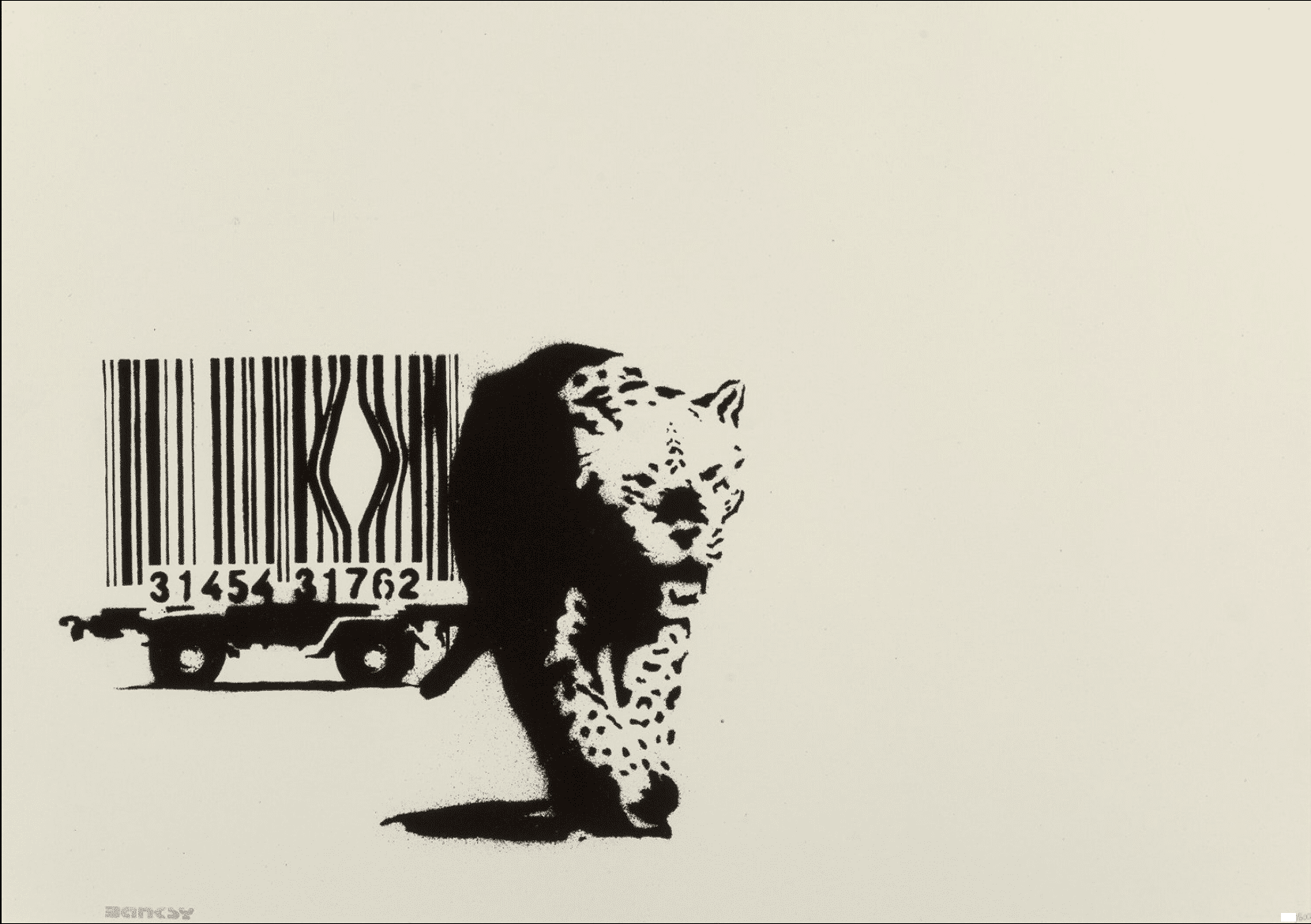
Barcode (Unsigned)
by Banksy
Year: 2004
Medium: Screenprint on paper
Size: 50 × 70cm
Edition of 600
Stamped with the red Banksy tag as issued
Numbered from the edition of 600 in pencil.
Pest Control Certificate Included
Banksy’s Barcode (Unsigned) (2004) is a striking screenprint on paper measuring 50 × 70 cm, issued in an edition of 600. Transforming a simple barcode into a powerful statement on consumerism, mass production, and humanity’s impact on the natural world, the work exemplifies Banksy’s sharp visual storytelling. Numbered in pencil and stamped with the original red Banksy tag, it is further supported by a Pest Control Certificate, providing trusted authenticity and provenance for collectors.
Barcode is one of Banksy’s most recognizable commentaries on consumer culture. First appearing as a street artwork in the early 2000s, the image features a tiger emerging from a barcode, transforming an everyday retail symbol into a powerful visual statement. The work quickly became associated with Banksy’s critique of mass consumption and the growing influence of commercial systems on modern life.
The barcode serves as a symbol of standardization, control, and consumer behavior, while the escaping tiger represents freedom, individuality, and the natural world pushing back against confinement. Through this striking contrast, Banksy explores themes of capitalism, commodification, and the tension between nature and commerce. Like many of his most successful works, Barcode delivers a complex message through a simple and instantly recognizable image.
Among collectors, Barcode remains a highly desirable Banksy edition due to its iconic imagery and enduring relevance. Limited edition examples are increasingly difficult to source, supporting strong demand in the secondary market. Its combination of cultural significance, visual impact, and classic Banksy symbolism has secured its place as one of the artist’s most important and collectible works.
Banksy is a world-famous British street artist known for politically charged graffiti and an anonymous identity. Emerging from the Bristol underground scene in the 1990s, Banksy became a leading figure connecting street art, graffiti art, and contemporary art movements. His work combines satire, activism, and social commentary in ways that connect with both casual viewers and serious collectors.
Banksy’s iconic works, such as Girl with Balloon, Flower Thrower, and Love is in the Bin helped define his career and transformed street art into a respected part of the global art market. His visual style is instantly recognizable through stencil techniques, bold black-and-white contrasts, and sharp messages about war, consumerism, and inequality.
Banksy holds major market importance because his original works and authenticated prints regularly sell for millions at international auctions. Demand remains strong among collectors due to limited supply, global recognition, and cultural relevance.
Beyond the market, Banksy changed how people view public art. He brought graffiti into galleries, museums, and mainstream culture while keeping its rebellious spirit alive. From an investment perspective, Banksy is considered one of the strongest contemporary art names, with steady collector demand and long-term appeal across generations.
More Banksy Works to Explore





Barcode (Unsigned)
by Banksy
Year: 2004
Medium: Screenprint on paper
Size: 50 × 70cm
Edition of 600
Banksy’s Barcode (Unsigned) (2004) is a striking screenprint on paper measuring 50 × 70 cm, issued in an edition of 600. Transforming a simple barcode into a powerful statement on consumerism, mass production, and humanity’s impact on the natural world, the work exemplifies Banksy’s sharp visual storytelling. Numbered in pencil and stamped with the original red Banksy tag, it is further supported by a Pest Control Certificate, providing trusted authenticity and provenance for collectors.
Barcode is one of Banksy’s most recognizable commentaries on consumer culture. First appearing as a street artwork in the early 2000s, the image features a tiger emerging from a barcode, transforming an everyday retail symbol into a powerful visual statement. The work quickly became associated with Banksy’s critique of mass consumption and the growing influence of commercial systems on modern life.
The barcode serves as a symbol of standardization, control, and consumer behavior, while the escaping tiger represents freedom, individuality, and the natural world pushing back against confinement. Through this striking contrast, Banksy explores themes of capitalism, commodification, and the tension between nature and commerce. Like many of his most successful works, Barcode delivers a complex message through a simple and instantly recognizable image.
Among collectors, Barcode remains a highly desirable Banksy edition due to its iconic imagery and enduring relevance. Limited edition examples are increasingly difficult to source, supporting strong demand in the secondary market. Its combination of cultural significance, visual impact, and classic Banksy symbolism has secured its place as one of the artist’s most important and collectible works.
Banksy is a world-famous British street artist known for politically charged graffiti and an anonymous identity. Emerging from the Bristol underground scene in the 1990s, Banksy became a leading figure connecting street art, graffiti art, and contemporary art movements. His work combines satire, activism, and social commentary in ways that connect with both casual viewers and serious collectors.
Banksy’s iconic works, such as Girl with Balloon, Flower Thrower, and Love is in the Bin helped define his career and transformed street art into a respected part of the global art market. His visual style is instantly recognizable through stencil techniques, bold black-and-white contrasts, and sharp messages about war, consumerism, and inequality.
Banksy holds major market importance because his original works and authenticated prints regularly sell for millions at international auctions. Demand remains strong among collectors due to limited supply, global recognition, and cultural relevance.
Beyond the market, Banksy changed how people view public art. He brought graffiti into galleries, museums, and mainstream culture while keeping its rebellious spirit alive. From an investment perspective, Banksy is considered one of the strongest contemporary art names, with steady collector demand and long-term appeal across generations.