


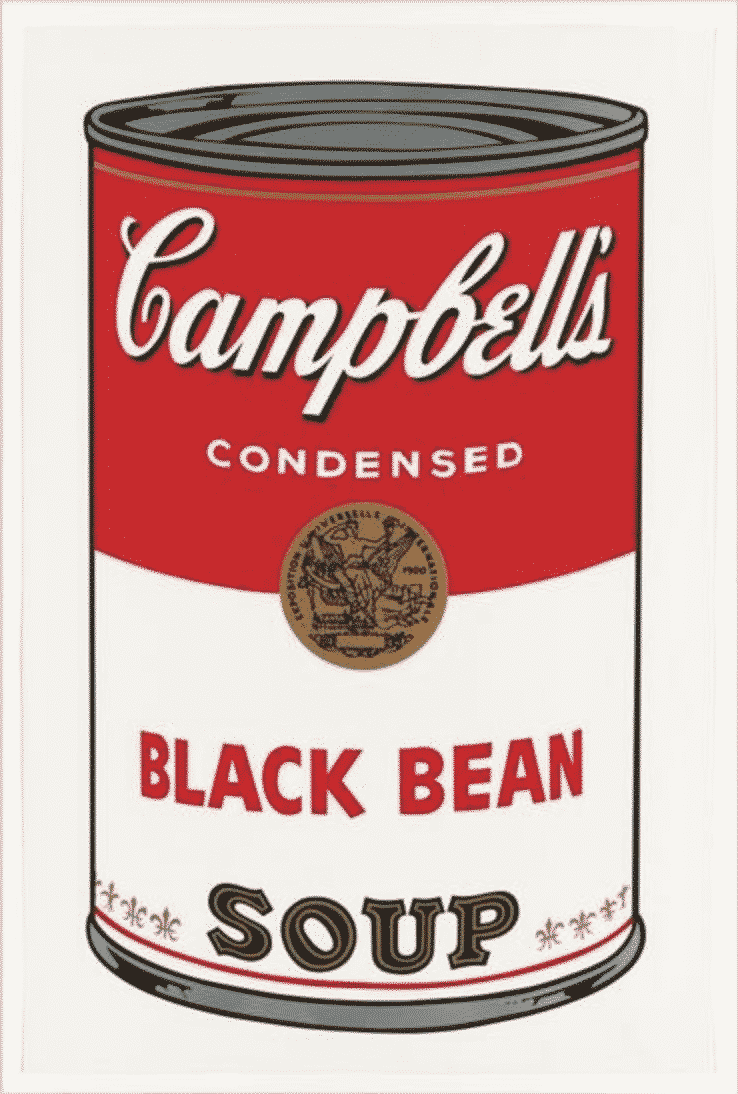
Campbell’S Soup - Black Bean (Fs Ii.44)
by Andy Warhol
Year: 1968
Medium: Screenprint on Lenox Museum Board
Size: 35 × 23 in (88.9 × 58.4 cm)
Edition of 250
Signed and Numbered in Ballpoint pen
An enduring icon of American Pop Art, Andy Warhol’s Campbell’s Soup – Black Bean (FS II.44) (1968) is a 35 × 23-inch screenprint on Lenox Museum Board. Warhol transforms an everyday supermarket label into a meditation on branding, consumerism, and mass production. Signed and numbered in ballpoint pen from an edition of 250, this distinctive example carries strong historical relevance and collector appeal.
Campbell’s Soup – Black Bean (F. S. II.44) belongs to Andy Warhol’s landmark Campbell’s Soup series, which first captured public attention in 1962 at the Ferus Gallery in Los Angeles. By elevating a supermarket label into fine art, Warhol turned a familiar product into a lasting symbol of American consumer culture. The Black Bean variety adds a darker, more graphic character while preserving the repetition and commercial clarity that define the series.
There is no recognized street-graffiti version. The work’s strength lies in Warhol’s precise Pop Art treatment, where packaging, repetition, and scale transform an ordinary food product into an icon. Its themes include mass production, branding, routine, and the blurred boundary between commerce and art.
For collectors, F. S. II.44 carries the appeal of Warhol’s most important early subject. Demand for Campbell’s Soup works remains strong, while rarity, condition, edition details, signature, and provenance can shape value. In my experience, these works offer immediate recognition and enduring Pop Art relevance.
Warhol understood that the simplest image could carry the biggest cultural charge.
The work connects to his early 1960s Pop period and to related Campbell’s Soup, Coca-Cola, and Brillo imagery. It is a smart choice for collectors seeking a recognizable, historically important Warhol with strong visual impact.
More Andy Warhol Works to Explore
Campbell’S Soup - Black Bean (Fs Ii.44)
by Andy Warhol
Year: 1968
Medium: Screenprint on Lenox Museum Board
Size: 35 × 23 in (88.9 × 58.4 cm)
Edition of 250
An enduring icon of American Pop Art, Andy Warhol’s Campbell’s Soup – Black Bean (FS II.44) (1968) is a 35 × 23-inch screenprint on Lenox Museum Board. Warhol transforms an everyday supermarket label into a meditation on branding, consumerism, and mass production. Signed and numbered in ballpoint pen from an edition of 250, this distinctive example carries strong historical relevance and collector appeal.
Campbell’s Soup – Black Bean (F. S. II.44) belongs to Andy Warhol’s landmark Campbell’s Soup series, which first captured public attention in 1962 at the Ferus Gallery in Los Angeles. By elevating a supermarket label into fine art, Warhol turned a familiar product into a lasting symbol of American consumer culture. The Black Bean variety adds a darker, more graphic character while preserving the repetition and commercial clarity that define the series.
There is no recognized street-graffiti version. The work’s strength lies in Warhol’s precise Pop Art treatment, where packaging, repetition, and scale transform an ordinary food product into an icon. Its themes include mass production, branding, routine, and the blurred boundary between commerce and art.
For collectors, F. S. II.44 carries the appeal of Warhol’s most important early subject. Demand for Campbell’s Soup works remains strong, while rarity, condition, edition details, signature, and provenance can shape value. In my experience, these works offer immediate recognition and enduring Pop Art relevance.
Warhol understood that the simplest image could carry the biggest cultural charge.
The work connects to his early 1960s Pop period and to related Campbell’s Soup, Coca-Cola, and Brillo imagery. It is a smart choice for collectors seeking a recognizable, historically important Warhol with strong visual impact.