
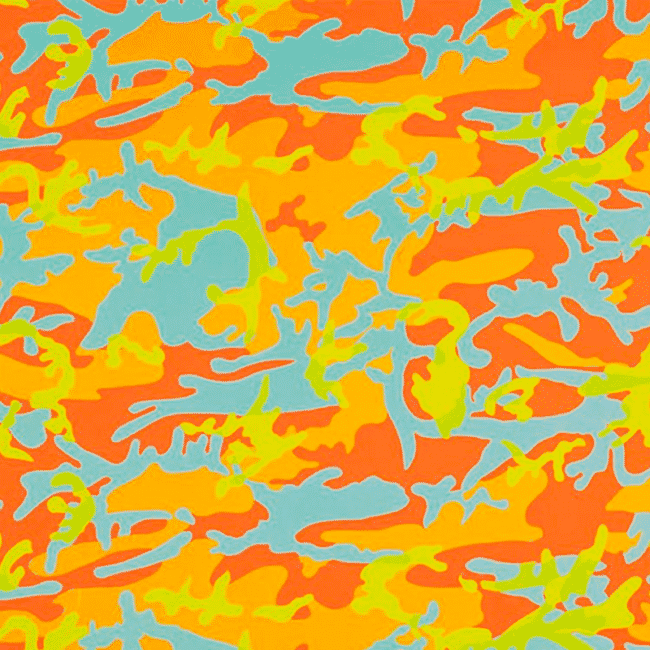
Camouflage 413
by Andy Warhol
Year: 1987
Medium: Screen print on Lenox Museum Board
Size: 38 x 38 in (96.52 x 96.52 cm)
Edition: 80
Signed
A compelling fusion of art and military imagery, Andy Warhol’s Camouflage 413 (1987) is a 38 × 38-inch screenprint on Lenox Museum Board. From his final major series, the work reimagines camouflage as a vivid pattern of concealment, identity, and visual culture. Signed and produced in an edition of only 80, this rare example offers commanding scale, distinctive graphic character, and notable appeal for serious Pop Art collectors.
Camouflage 413 by Andy Warhol belongs to his celebrated 1986 Camouflage series, created during the final years of his career. The pattern first appears in Warhol’s paintings and prints based on military camouflage, transforming a functional design into a vivid Pop image. Here, camouflage shifts from concealment to spectacle, raising ideas of identity, conflict, fashion, and visibility.
There is no recognized street-graffiti version. Warhol’s camouflage works were produced through his studio screen-printing process, where repeated patterns and bold color became the subject itself. The tension is compelling: camouflage is meant to hide, yet Warhol makes it impossible to ignore.
For collectors, Camouflage 413 holds strong market appeal as part of Warhol’s late, highly recognizable body of work. The series is widely collected, and individual works can vary greatly in desirability based on scale, color, edition, condition, and provenance. Strong examples remain attractive to collectors seeking a distinctive late Warhol.
From our gallery perspective, the brilliance lies in the contradiction. Warhol takes a symbol of military concealment and turns it into luxury, fashion, and visual excess.
The work connects to Warhol’s late fascination with repetition and mass imagery, alongside his Self-Portraits, Flowers, and other 1980s works. It is a sharp example of how Warhol kept reinventing familiar images until they became unmistakably his own.
More Andy Warhol Works to Explore
Camouflage 413
by Andy Warhol
Year: 1987
Medium: Screen print on Lenox Museum Board
Size: 38 x 38 in (96.52 x 96.52 cm)
Edition: 80
A compelling fusion of art and military imagery, Andy Warhol’s Camouflage 413 (1987) is a 38 × 38-inch screenprint on Lenox Museum Board. From his final major series, the work reimagines camouflage as a vivid pattern of concealment, identity, and visual culture. Signed and produced in an edition of only 80, this rare example offers commanding scale, distinctive graphic character, and notable appeal for serious Pop Art collectors.
Camouflage 413 by Andy Warhol belongs to his celebrated 1986 Camouflage series, created during the final years of his career. The pattern first appears in Warhol’s paintings and prints based on military camouflage, transforming a functional design into a vivid Pop image. Here, camouflage shifts from concealment to spectacle, raising ideas of identity, conflict, fashion, and visibility.
There is no recognized street-graffiti version. Warhol’s camouflage works were produced through his studio screen-printing process, where repeated patterns and bold color became the subject itself. The tension is compelling: camouflage is meant to hide, yet Warhol makes it impossible to ignore.
For collectors, Camouflage 413 holds strong market appeal as part of Warhol’s late, highly recognizable body of work. The series is widely collected, and individual works can vary greatly in desirability based on scale, color, edition, condition, and provenance. Strong examples remain attractive to collectors seeking a distinctive late Warhol.
From our gallery perspective, the brilliance lies in the contradiction. Warhol takes a symbol of military concealment and turns it into luxury, fashion, and visual excess.
The work connects to Warhol’s late fascination with repetition and mass imagery, alongside his Self-Portraits, Flowers, and other 1980s works. It is a sharp example of how Warhol kept reinventing familiar images until they became unmistakably his own.