
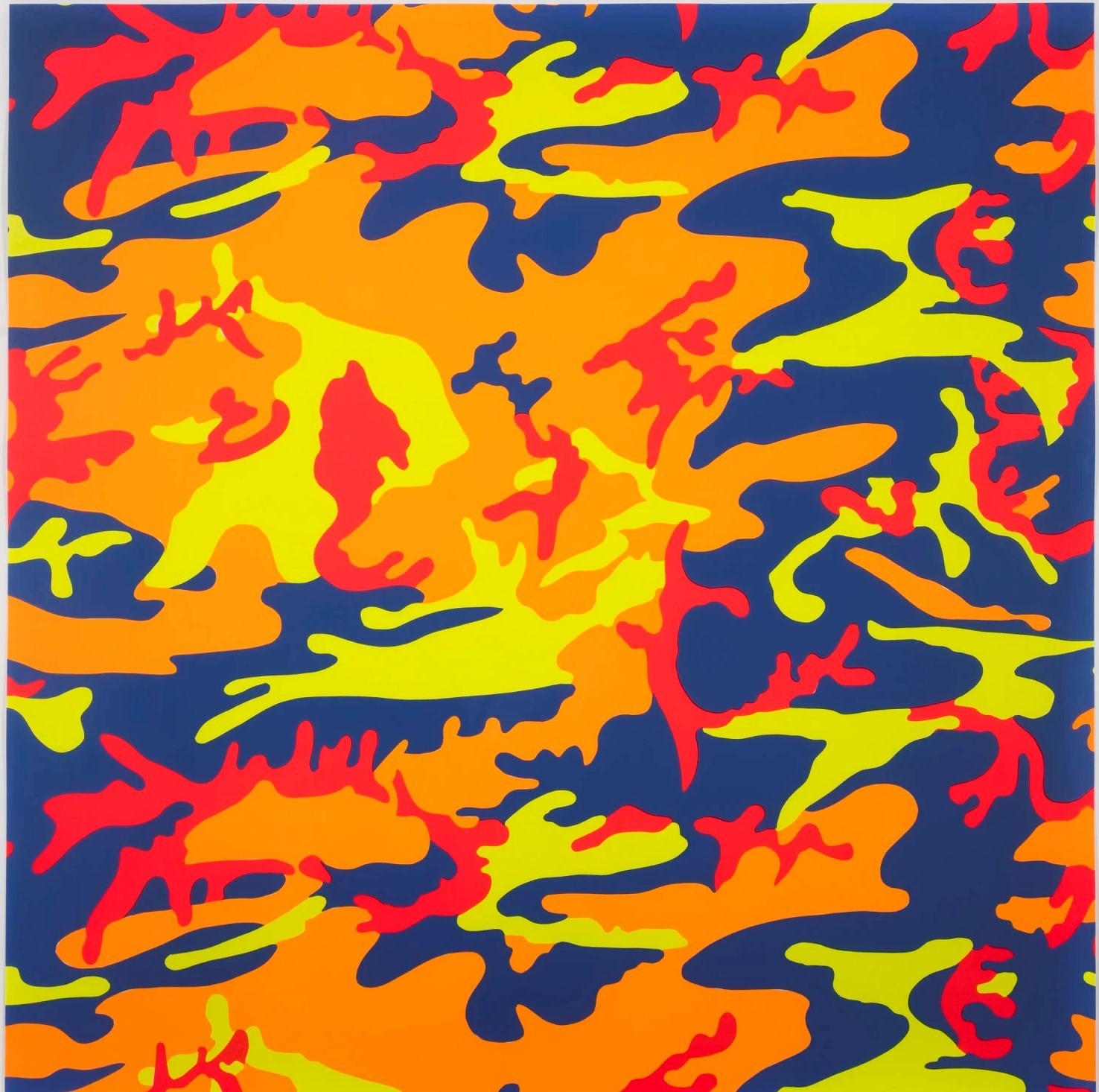
Camouflage 412
by Andy Warhol
Year: 1987
Medium: Screen print on Lenox Museum Board
Size: 38 x 38 in (96.52 x 96.52 cm)
Edition: 80
Signed
With its bold interplay of concealment and display, Andy Warhol’s Camouflage 412 (1987) reimagines military pattern as a sophisticated Pop Art motif. Executed as a 38 × 38-inch screenprint on Lenox Museum Board, the signed work comes from a scarce edition of 80. Its striking geometry, late-career significance, and limited availability give this example particular appeal for collectors seeking distinctive works by Warhol.
Camouflage 412 by Andy Warhol belongs to his late Camouflage series, first shown in 1986 at the Gagosian Gallery in New York. Warhol took a pattern linked to military concealment and transformed it into vibrant Pop Art, replacing its practical purpose with color, rhythm, and visual spectacle. The camouflage pattern suggests secrecy, conflict, identity, and concealment, while Warhol’s bright palette turns something associated with war into an object of fashion and desire.
There is no recognized street-graffiti version. Warhol created the Camouflage works through his studio screen-printing practice, before street art adopted camouflage as a major visual language.
For collectors, Camouflage 412 is attractive because the series sits within Warhol’s important late career, when he continued to reinvent familiar images through bold color and repetition. Rarity, edition, condition, provenance, and color combination all influence desirability and market value.
From our gallery perspective, the appeal is immediate: Warhol takes a military pattern and makes it feel luxurious, graphic, and collectible.
Artistically, Camouflage 412 connects with Warhol’s Self-Portraits, Flowers, Dollar Signs, and celebrity works, sharing his fascination with repetition and recognizable symbols. For collectors seeking a sophisticated late Warhol with strong visual impact, this is a compelling choice.
More Andy Warhol Works to Explore
Camouflage 412
by Andy Warhol
Year: 1987
Medium: Screen print on Lenox Museum Board
Size: 38 x 38 in (96.52 x 96.52 cm)
Edition: 80
With its bold interplay of concealment and display, Andy Warhol’s Camouflage 412 (1987) reimagines military pattern as a sophisticated Pop Art motif. Executed as a 38 × 38-inch screenprint on Lenox Museum Board, the signed work comes from a scarce edition of 80. Its striking geometry, late-career significance, and limited availability give this example particular appeal for collectors seeking distinctive works by Warhol.
Camouflage 412 by Andy Warhol belongs to his late Camouflage series, first shown in 1986 at the Gagosian Gallery in New York. Warhol took a pattern linked to military concealment and transformed it into vibrant Pop Art, replacing its practical purpose with color, rhythm, and visual spectacle. The camouflage pattern suggests secrecy, conflict, identity, and concealment, while Warhol’s bright palette turns something associated with war into an object of fashion and desire.
There is no recognized street-graffiti version. Warhol created the Camouflage works through his studio screen-printing practice, before street art adopted camouflage as a major visual language.
For collectors, Camouflage 412 is attractive because the series sits within Warhol’s important late career, when he continued to reinvent familiar images through bold color and repetition. Rarity, edition, condition, provenance, and color combination all influence desirability and market value.
From our gallery perspective, the appeal is immediate: Warhol takes a military pattern and makes it feel luxurious, graphic, and collectible.
Artistically, Camouflage 412 connects with Warhol’s Self-Portraits, Flowers, Dollar Signs, and celebrity works, sharing his fascination with repetition and recognizable symbols. For collectors seeking a sophisticated late Warhol with strong visual impact, this is a compelling choice.