
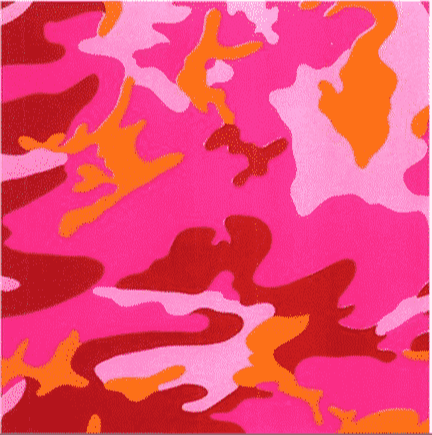
Camouflage 408
by Andy Warhol
Year: 1987
Medium: Screen print on Lenox Museum Board
Size: 38 x 38 in (96.52 x 96.52 cm)
Edition: 80
Signed
Emerging from Andy Warhol’s late exploration of military imagery, Camouflage 408 (1987) reimagines a familiar pattern through the heightened language of Pop Art. This 38 × 38-inch screenprint on Lenox Museum Board is signed and drawn from an edition of 80. Its commanding scale, limited production, and distinctive graphic vocabulary offer considerable appeal to collectors seeking a refined example of Warhol’s late-period printmaking.
Camouflage 408 belongs to Andy Warhol’s late Camouflage series, created in 1986–87 during the final years of his career. Warhol adapted a military camouflage pattern and transformed it through silkscreen, scale, and unexpected colour. The series was first presented in New York in 1986, linking a symbol of war and concealment with the language of Pop art. There is no original street-graffiti version: Warhol made the Camouflage works within his studio practice, not as public-wall pieces.
The work turns camouflage into a visual paradox. A pattern meant to hide becomes impossible to ignore, raising ideas of identity, power, conflict, disguise, and visibility. Its layered shapes also recall abstract painting while retaining a clear connection to mass-produced imagery.
For collectors, Camouflage is important as one of Warhol’s final major series. Individual colour combinations can be scarce and highly distinctive, with demand supported by the strength of Warhol’s late market.
From our gallery experience, Camouflage 408 has the kind of immediate impact that works beautifully in a contemporary collection. Its graphic structure remains fresh decades later.
The series connects Warhol’s Pop language with his late Self-Portraits and other image-based works. For collectors seeking a bold late-period Warhol, Camouflage 408 offers strong visual presence and lasting art-historical relevance.
More Andy Warhol Works to Explore
Camouflage 408
by Andy Warhol
Year: 1987
Medium: Screen print on Lenox Museum Board
Size: 38 x 38 in (96.52 x 96.52 cm)
Edition: 80
Emerging from Andy Warhol’s late exploration of military imagery, Camouflage 408 (1987) reimagines a familiar pattern through the heightened language of Pop Art. This 38 × 38-inch screenprint on Lenox Museum Board is signed and drawn from an edition of 80. Its commanding scale, limited production, and distinctive graphic vocabulary offer considerable appeal to collectors seeking a refined example of Warhol’s late-period printmaking.
Camouflage 408 belongs to Andy Warhol’s late Camouflage series, created in 1986–87 during the final years of his career. Warhol adapted a military camouflage pattern and transformed it through silkscreen, scale, and unexpected colour. The series was first presented in New York in 1986, linking a symbol of war and concealment with the language of Pop art. There is no original street-graffiti version: Warhol made the Camouflage works within his studio practice, not as public-wall pieces.
The work turns camouflage into a visual paradox. A pattern meant to hide becomes impossible to ignore, raising ideas of identity, power, conflict, disguise, and visibility. Its layered shapes also recall abstract painting while retaining a clear connection to mass-produced imagery.
For collectors, Camouflage is important as one of Warhol’s final major series. Individual colour combinations can be scarce and highly distinctive, with demand supported by the strength of Warhol’s late market.
From our gallery experience, Camouflage 408 has the kind of immediate impact that works beautifully in a contemporary collection. Its graphic structure remains fresh decades later.
The series connects Warhol’s Pop language with his late Self-Portraits and other image-based works. For collectors seeking a bold late-period Warhol, Camouflage 408 offers strong visual presence and lasting art-historical relevance.